On June 24, BeThere Immersive brought together industry leaders from construction, manufacturing, and law enforcement at Conflux Co-Learning in St. Louis for a direct conversation about one of the most persistent problems in workforce development: the gap between what workers are told about a job and what they actually experience when they show up.
The event — Immersive Technology & the Future of Workforce Development — wasn’t a trade show. It was a working session. Leaders from across the region came to hear honest perspectives on where VR workforce development stands today, and how we can partner together to continue building out this next generation of workers.
VR 1.0 Failed. Here’s Why VR 2.0 Is a Different Story.
For more than a decade, enterprise VR came with a catch. Custom-built simulations ran $75,000 to $500,000 per module, took months to produce, and were outdated before most organizations got real use out of them. The hardware was clunky, the experiences felt like video games, and the whole thing rarely moved past a pilot.
BeThere Immersive Founder and CEO Eric Margheim opened the morning by naming that history directly — and explaining why the conditions that broke VR 1.0 have fundamentally changed.
The shift isn’t incremental. Hardware is lighter and cheaper, with real competition between platforms. AI is collapsing production timelines that used to require specialized development teams. And reality capture — the ability to turn an actual job site, production floor, or facility into an immersive experience — has become accessible enough that a safety manager or a recruiting lead can do it themselves, without writing a line of code.
“Capture, upload, create, deploy,” Eric described it. One person on a job site with a 360-degree camera. A couple of hours. Content that goes directly into a VR experience your workforce can use the same week.
That’s not VR 1.0. The economics are different. The workflow is different. And the organizations that start now build a content library that compounds over time.
The Real Problem Isn’t Technology. It’s the Experience Gap.
The event wasn’t framed around VR as a technology. It was framed around a workforce problem that every person in the room already knew.
Thirty percent of workers leave a job within the first 90 days. The top reason, according to Jobvite research, is that the day-to-day role wasn’t what they expected. That’s not a sourcing problem. That’s not a compensation problem. It’s a gap between what candidates are told and what they actually encounter when they show up.
BeThere Immersive calls this the Experience Gap — and it’s the thread that connects every use case the platform supports.
In recruiting, it means letting candidates see the actual work environment before they apply or accept. In onboarding, it means giving new hires real familiarity with the space, the equipment, and the pace before their first day. In training, it means preparing workers for hazardous situations, complex procedures, and high-pressure scenarios before the stakes are real.
The goal isn’t to make every candidate comfortable with the job. The goal is to make sure the right people self-select in, and the wrong people self-select out — before anyone wastes time, money, or goodwill finding out the hard way.
Two Other Perspectives Worth Noting
Eric wasn’t the only voice in the room.
Drew Crowe from The MFG Renaissance talked about reaching the next generation of workers — and specifically about changing the story students hear about careers in the skilled trades. The pipeline problem doesn’t start on day one of employment. It starts in middle school, when students form opinions about what manufacturing, construction, and public safety actually look like. Immersive technology is one of the few tools that can close that gap before a student ever sets foot on a job site.
Derek Weber, Founder of Lead with AI, brought a grounded perspective on AI as a practical workforce and operations tool — not as an abstract future concept, but as something organizations in this room can use today to train, operate, and grow their teams more efficiently.
Give a quick listen here on some of the topics discussed.
What Attendees Experienced Firsthand
Good conversations continued after presentations about how VR and immersive experiences can work for education purposes and expose students to opportunities that they wouldn’t have known otherwise.
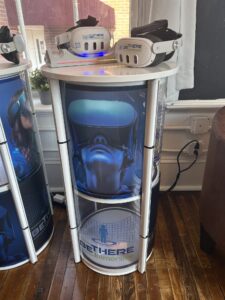
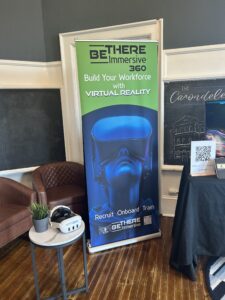
After the morning presentations, we had lunch and live demos — a chance for attendees to step into BeThere Immersive’s BTI VR Platform and see the technology for themselves, not just hear about it.
That’s the moment that tends to land. Reading about VR workforce development is one thing. Standing inside a real production floor or a law enforcement training scenario — and understanding that the experience was captured with a 360-degree camera, not built by a development team — is another.
What This Means for Your Organization
The organizations in that room weren’t there because they’ve already figured out workforce development. They were there because the problem is real, the old approaches aren’t keeping up, and something is changing in what’s actually possible.
If your organization is losing new hires in the first 90 days, running thin on pipeline, or trying to prepare workers for environments that are too dangerous or too expensive to practice in — the technology to address that is no longer theoretical. It’s in use today, by manufacturers, construction firms, and public safety agencies across the Midwest.
BeThere Immersive works with organizations like Diamond Pet Foods, Emery Sapp & Sons, MFA Incorporated, Ranken Tech, and the Missouri State Highway Patrol — not to pitch VR, but to close a specific gap that’s costing them time, money, and people.
If you want to understand what that looks like for your operation, start here: bethereimmersive.com